A factory in Poland or Germany does not accept a shiny tanker. It accepts a food-grade tank with a wash, a load history, a temperature plan and fittings it can connect. An EU trip without those four points is a rate that will be rebuilt at the gate.
Product first, then a food-grade tank
Sunflower and rapeseed oils are a working specialism of KDM Cargo: LAG and Magyar stainless 32 m³ tanks, steam jacket and air on the whole fleet. That kit still has to match this batch and this plant — see food-grade transport.
Syrups, dairy and juices are food-grade too, with tighter wash and temperature rules. Do not label every food liquid “oil logistics”. Name the product.
Wash and previous cargo: two questions
EU plants often send an allowed-previous-cargo list. Send it with the request. Wash type and history are checked together — wash and compatibility.
A partner wash certificate is per tanker, not a generic PDF. If the list is missing, write that you will confirm with the plant. Guessing a food wash to “look ready” wastes a slot.
Europe is a set of countries, not a blob
Europe is confirmed per state. Poland, Germany, Lithuania, Czechia — different slots, different papers, different racks. Write the country. If you do not know it yet, write the region you do know.
A Belarus origin plus an EU plant is a corridor with a border, not an inner-city shuttle. Empty positioning of a matching food tank still sits in the rate.
If the chain needs a transfer at the EU border, that is another operation — transshipment is written for chemicals; food-grade transfers need a food contour on both sides, not a silent pump-over.
Temperature, viscosity, discharge
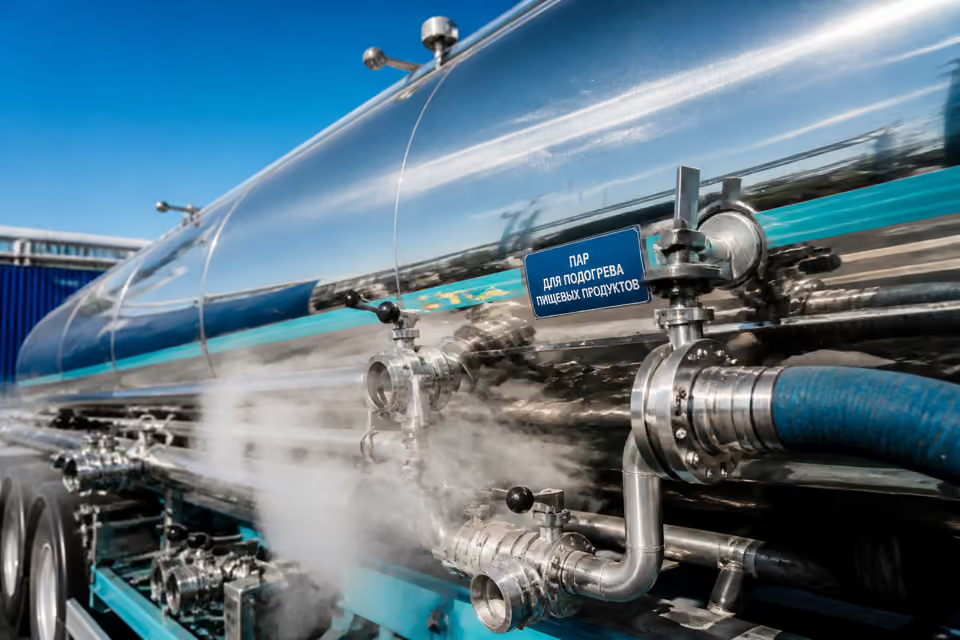
Winter oils thicken. The fleet has a steam jacket; the plant must have steam if we plan to use it. Steam jacket explains when heat is part of clearance.
Bottom or top discharge, air allowed or not — one line in the request saves a wrong fitting. Air connection is on every trailer; the rack must still accept it.
We will match a tanker to your product
Send a phone number and the job in your own words. Product, volume and corridor speed clearance — with no price promised without parameters.
Papers for the quote vs papers for loading
For a first calculation: product, tonnes, EU country, week, phone, wash rule if it exists. For loading: certificate on the assigned tank, windows, plant codes. Split is in documents for a quote.
We do not freeze a “Europe rate” without a country. A number without a plant is a brochure.
What to count before you compare rates
Matching food tank, wash, empty run, slot, heat time, possible weekend dead rack. Two numbers without that breakdown are two different jobs — see tank transport rate.
Own fleet vs forwarding does not cancel the food contour. Attracted trucks are checked the same way before we put your batch on them.
When a food-grade EU trip should wait
No wash rule and a strict plant, no country, ADR-looking SDS on a “food” nickname — we stop and ask. Better a delayed confirmation than a rejected tanker in Poland.
If the product is not food-grade after all, the line changes. We will say so. We will not keep a food tank on a chemical job to protect the first email.
Example: Belarus origin, EU plant
“24 t rapeseed, food-grade, Brest region → Poznań, Friday loading, receiver wants a food wash paper, bottom discharge.” That is a job. We check a food tank, wash programme, jacket if the week is cold, and the Polish slot.
Swap Poznań for “Germany” without a city — the rate opens again. Swap food-grade for technical oil — the tank history changes.
When those four checks exist, send the request. The quote follows the tank that the plant can accept.
Food-grade export checklist
- Product and food vs technicalOils: grade matters
- EU country (and city if known)Not “Europe”
- Wash / previous-cargo rulePlant list or quote
- Discharge type and steamBottom/top, air, steam yes/no
Телефон и задача своими словами — достаточно, чтобы начать сверку цистерны.
Ask about the corridor
Do you haul food-grade to any EU country?
Countries are confirmed per route. Name the state. We do not publish a decorative list of “all Europe”.
Is a stainless tank enough for the EU?
No. Wash, history and the plant’s list sit above the metal. See food-grade tanker standards.
Can you go around a missing wash paper?
No. If the plant requires it, the trip waits for the paper or another tank.
Do you heat oils into the EU in winter?
When viscosity and the site require it, and when steam exists at discharge. Jacket is on the fleet; regime is per batch.
What if the load is food but the SDS looks ADR?
We classify from papers. A food nickname does not override an ADR file.
How do I start?
Product, tonnes, EU country, phone. Contacts.
We will match a tanker to the product
A phone number and the job in your own words are enough to start.